
Recent research in Cape Town and Helsinki
Recent research in Cape Town and Helsinki: tracing archives of synagogue music
Two researchers from the Performing the Jewish Archive project (Principal Investigator Steve Muir and Post-Doctoral Research Fellow Simo Muir) recently conducted research in two of the most widely-separated communities in the world, Cape Town and Helsinki. Just as the two researchers share a common Scottish ancestry but no apparent family links, so the two communities share a distinctly Litvak heritage despite their geographical disparity, affording the potential for some interesting comparisons in the future.
Steve Muir spent two weeks in South Africa in March 2015, continuing his work into the choral and cantorial music of Russian and East European Jewish synagogue composers who emigrated to Cape Town in the early twentieth century. Back in 2013 he had stumbled across large private manuscript collections of such music, dating back to the early 1900s and otherwise forgotten or thought lost. Most prominent was Dowid Ajzensztadt’s Passover cantata Chad Gadya [One Little Goat], performed in Warsaw in 1931. Further discoveries ensued, such as manuscripts from 1918 by Dawid Nowakowsky of Odessa, most of whose manuscripts are now in New York, and Froim Spektor of Rostov-on-Don. Several of these pieces will be performed at this year’s ‘Magnified and Sanctified’ conference (16–19 June 2015), PtJA’s first international conference.
 This year Steve conducted research in the archives of the University of Cape Town, studying the minute books of various Cape Town synagogues. Thanks are due particularly to Juan-Paul Burke of UCT’s Jewish Studies Library for his assistance. Steve followed up on a number of new research leads, including the music of Cantor Samuel Katzin of Riga, in the possession of his daughter in Cape Town. This proved a veritable treasure trove of manuscripts and early printed editions, featuring music by Katzin himself and several others. Particularly interesting were settings of liturgical texts for cantor, organ, violin and ’cello by Spektor, along with other vocal–instrumental settings by Spektor’s Rostov organist Gottbeter.
Clearly all these figures knew each other well and regularly circulated music among themselves. The next task will be to sift through this music (much of which represents a lost, almost forgotten compositional world), try to trace more concretely the connections between the various personalities involved, and understand the impact of migration upon these composers and their music. This will lead to an article and, hopefully, some published editions of the music.
Steve also had the opportunity to meet up with several of PtJA’s important partners in South Africa, including: Richard Freedman and Michal Singer at the South Africa Holocaust and Genocide Foundation, with whom we will develop a new exhibition; Peter Martens from Stellenbosch Conservatorium, who will support the project’s Cape Festival; and colleagues from the South African College of Music at UCT, who will also support the Festival. Steve was also generously hosted by the Isaac and Jessie Kaplan Centre for Jewish Studies and Research and UCT.
The final few days of the visit were spent in Johannesburg (South Africa’s largest Jewish community), exploring several new research possibilities, and meeting some of the key figures in Johannesburg’s Jewish musical establishment. What became clear in a tantalisingly short visit is the range of musical achievements and the potentially rich vein of materials that lay waiting to be rediscovered.
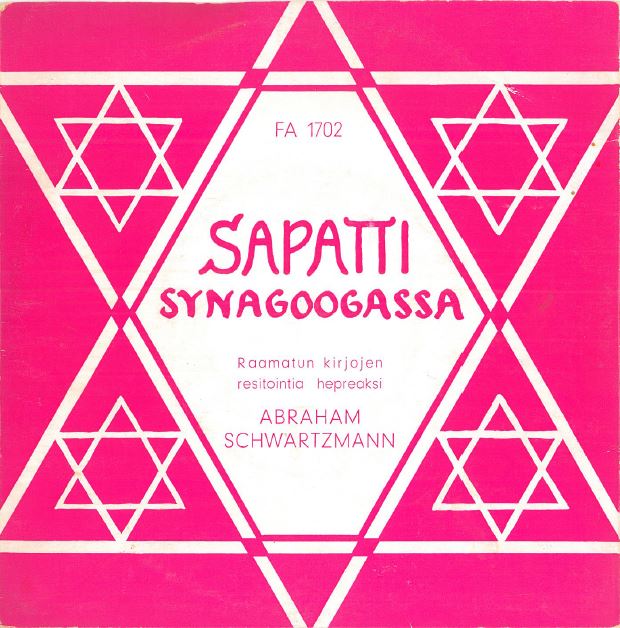
Recording of Torah cantillation in Helsinki from 1965
In March 2015 Simo Muir carried out ethnographic fieldwork in Finland about the country’s Jewish liturgical tradition. Jewish communities, now mainly in Helsinki and Turku, have existed in the country from the 1860s, but no one has previously paid attention to their synagogue music. The Jewish community in Finland can be considered one of the few Eastern European Jewish communities that has been able to continue Lithuanian Jewish (Litvak) traditions uninterrupted by the Second World War and the Holocaust.
During his trip Simo conducted several interviews with local members of the Jewish community including rabbis, cantors and prayer leaders about their memories and perceptions of the Finnish Jewish liturgical tradition. Simo was also able to collect rare post-war recordings of High Holidays melodies from Turku, and Torah cantillation in Helsinki.
The National Archives of Finland, which Simo also visited during his trip, has a large Finnish Jewish Archive, which includes documents relating to a Jewish choir in Helsinki and the correspondence of cantors who either worked permanently in Finland or were visiting the communities. The Jewish community in Helsinki was able to invite esteemed cantors from the capital of the Russian Empire, St. Petersburg, and later from Soviet Leningrad.
The aim of Simo’s research is to sketch an outline of the liturgical tradition in Finland, its origin, and the change it has faced in recent years. His aim is also to record fast-disappearing Eastern European Ashkenazi melodies during his future field trips.