
Leeds & York Festival Opens with Staging of Rediscovered Play at Clifford’s Tower
On 16th and 17th April an exceptional performance will launch the ‘Out of the Shadows: Rediscovering Jewish Music and Theatre’ festival. A recently recovered play written in the World War II Jewish ghetto at Terezín (in German, Theresienstadt) will be staged in Clifford’s Tower, a venue as historically bleak as the play’s origins. In 1190, York’s Jewish population took refuge in a castle on the site where Clifford’s Tower now stands, as they sought to escape the anti-Semitic riots sweeping the country. Besieged, most of the Jews chose to commit suicide; the survivors were killed by a murderous mob.
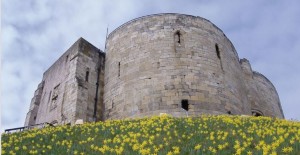
Clifford's Tower, York (Picture: English Heritage)
More than 800 years after that devastating event, the voices of Jewish artists will be heard within the walls of this English Heritage site. Students from the University of York, directed by alumnus Joe Lichtenstein, will stage ‘The Smoke of Home’ at 8pm and 9.30 pm on the 16th and 17th of April. The opening performance will be live streamed from 7.30pm via https://ptja.leeds.ac.uk/events/the-smoke-of-home/.
The play is the first of a series of performances in York and Leeds to take place in April and June under the banner Out of the Shadows: Rediscovering Jewish Music and Theatre. “This festival promises to be a poignant and uplifting programme of events celebrating the lives and achievements of Jewish artists,” said Dr Stephen Muir, a Senior Lecturer in Musicology and Performance at the University of Leeds’ School of Music and head of Performing the Jewish Archive a major research project to highlight such lost or forgotten works.
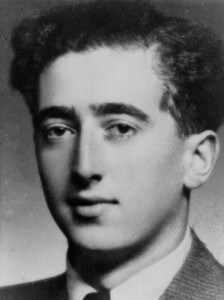
Jiří Stein
The Smoke of Home (Dým domova) is a historical allegory written in the ghetto by two young Czech Jews, Zdeněk Eliáš and Jiří Stein, and set in a prison tower during the Thirty Years’ War. According to Dr Lisa Peschel, Lecturer in Theatre at the University of York who brought the play to light, ‘the authors of this play posed a question that few of their fellow prisoners dared to face: if we survive, will there be a home to return to?’
Dr Peschel located the work after a Terezín survivor put her in touch with the Zdeněk Eliáš’s widow in the United States (he died in Seattle in 2000). Kate Elias found the script in her late husband’s safe, among his most important papers. Dorothy Elias, his daughter, then translated it into English. Eliáš’s co-author Jiří Stein perished in December 1944 after his deportation from the ghetto to Auschwitz.

Zdeněk and Kate Eliáš in 1999.
The cast and crew’s engagement with the script has been extraordinary. Stage manager Vita Ingram-Anichkin remarks, ‘coming from as troubled and fascinating a place as the Terezin Ghetto, the play is not just of great historical significance; it is also a beautiful piece of theatre in its own right’. Actor James Esler was struck by the way ‘the imprisonment of the characters resonates on many historical levels -- the context of its writing in Terezin, the subject matter of the Thirty Year’s War, and the venue of Cliffords Tower.’ Actor Christian Loveless agreed: ‘The setting of Clifford's Tower adds another layer of Jewish history to the already deeply significant script’.